NEURAL MECHANISMS ONLINE
  • Home
  • WebinarSeries
    • WebinarSeries2026
    • WebinarSeries2025
    • WebinarSeries2024
    • WebinarSeries2023
    • WebinarSeries2022
    • WebinarSeries2021
    • WebinarSeries2020
    • WebinarSeries2019
    • WebinarSeries2018
  • (Web)Conferences
    • Book symposium
    • ISPSM Conference
    • NCFM Conference
    • AISC-mid term 2019
  • How to connect
    • Troubleshooting
  • The team
  • Publications
  • VideoLectures
    • Free Will (short)
    • Mereological Fallacies (short)
    • Philosophy and Neuroscience (Roskies)
    • Neuroethics (Sinnott-Armstrong)
    • Memory (De Brigard)
    • Folk Psychology (Figdor)
    • Measuring Brain Function (Poldrack)
    • Explanation in Neuroscience (Chirimuuta)
  • Subscribe

17 May, Vincente RAJA & Michael ANDERSON [WEBINAR]

5/8/2019

0 Comments


17 May 2019
h 15-17 - Greenwhich Mean Time 

(check your local time here)

Vicente RAJA & Michael ANDERSON

(University of Western Ontario)

Behavior Considered as an Enabling Constraint

Join us online!
Picture
Picture
Ask for the paper!

Abstract

Two fundamental challenges of contemporary neuroscience are to make sense of the scalar relations in the nervous system and to understand the way behavior emerges from these relations while at the same time is affecting them. In this paper, we analyze the notion of enabling constraint and the way it can frame the two kinds of relations involved in the challenges: of different neural scales (e.g., molecular scale, genetic scale, single-neurons, neural networks, etc.) and between neural systems and behavior. We think the notion of enabling constraint provides a promising alternative to other classic, mechanistic understandings of these relations and the different issues contemporary neuroscience finds in them.
0 Comments

3 May, Jackie SULLIVAN [WEBINAR]

4/29/2019

0 Comments


3 May 2019
h 15-17 - Greenwhich Mean Time 

(check your local time here)​

Jackie SULLIVAN

(University of Western Ontario)

Optogenetics, Pluralism, and Progress

Join us online!
Picture
Ask for the paper!

Abstract

Optogenetic techniques are described as “revolutionary” for the unprecedented causal control they allow neuroscientists to exert over neural activity in awake-behaving animals. In this article, I demonstrate by means of a case study that optogenetic techniques will only illuminate causal links between the brain and behavior to the extent that their error characteristics are known and, further, that determining these error characteristics requires (1) comparison of optogenetic techniques with techniques having well-known error characteristics (methodological pluralism) and (2) consideration of the broader neural and behavioral context in which the targets of optogenetic interventions are situated (perspectival pluralism).
0 Comments

19 April, Ophelia DEROY [WEBINAR]

4/8/2019

1 Comment


19 April 2019
h 15-17 - Greenwhich Mean Time 
(check your local time here)

Ophelia DEROY 

(LMU Munich)

Unpredictable predictions : Defining and measuring cognition
​in predictive accounts of the mind

Join us online!
Picture
Ask for the paper!

Abstract

Distinguishing between perception and thought is a vacuous task. At least this is what most adopters of predictive coding accounts express. Here I want to argue for the opposite. Although I concur that perception can no longer be equated with strictly bottom-up processing, I argue that thought, in virtue of being at the top of the hierarchy, can be equated with a distinctive kind of process: It predicts but is not predicted by any other level. Using this argument and some recent collaborative experimental work on the much discussed example of racial biases in vision, I show why it makes a difference to the way we frame the issue of whether thought influences perception : What we have is a much more tractable and interesting problem of how much cognitive and metacognitive control we have over our perceptual biases.

1 Comment

17 April, Workshop in honour of Joe LeDoux [ONLINE/PHYSICAL]

4/8/2019

1 Comment


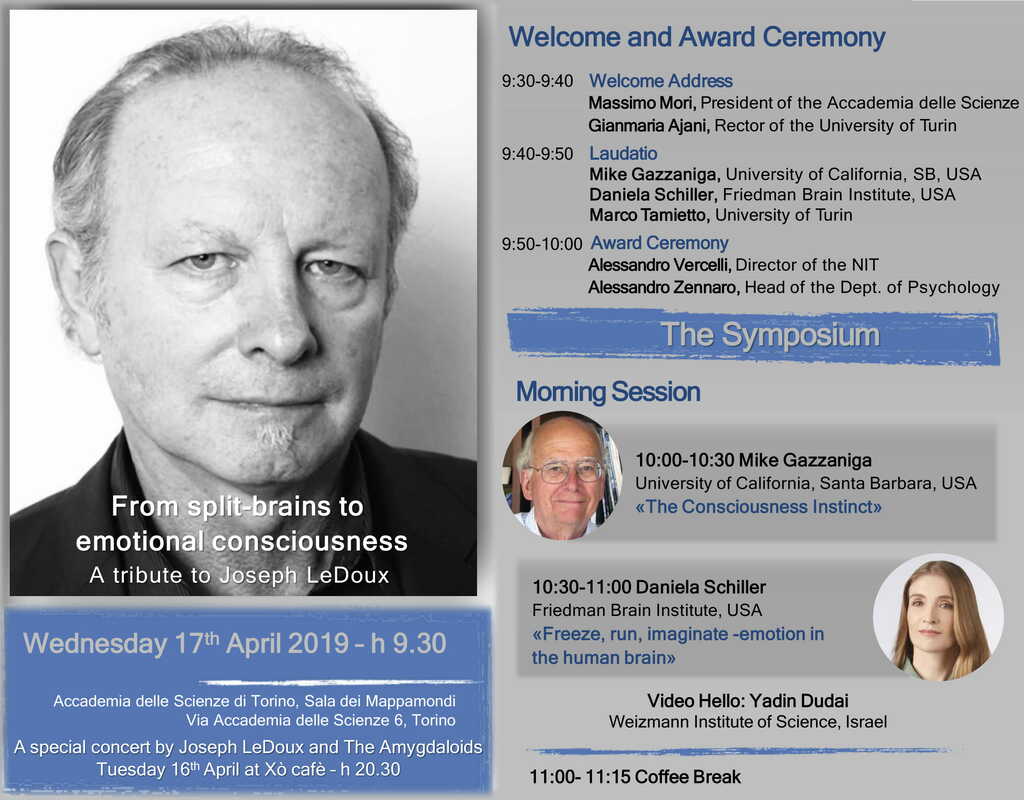
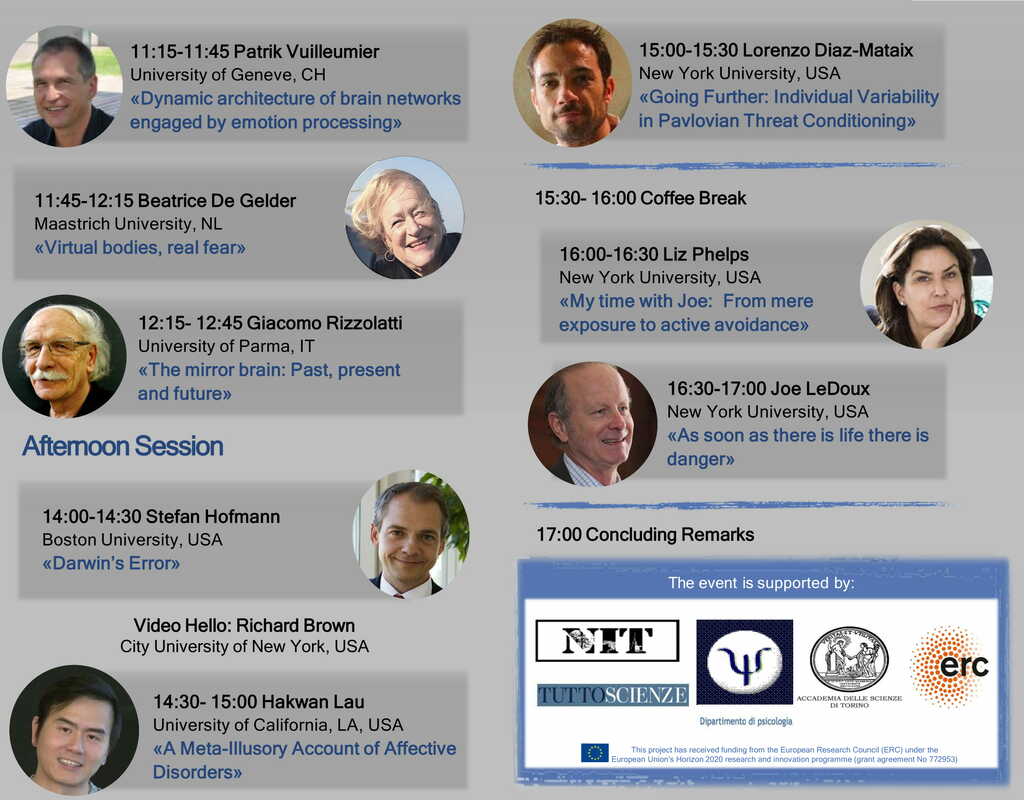
Workshop in honour of Joe LeDoux 

Wednesday 17thApril 2019 –h 7.30 GTM
(check your local time here)

From split-brains to emotional consciousness: 
A tribute to Joseph LeDoux

Join us online!
Picture
Picture
1 Comment

5 April, Miguel SEGUNDO ORTIN & ​Daniel HUTTO [WEBINAR]

4/3/2019

0 Comments


5 April 2019
h 8-10 - Greenwhich Mean Time 
(check your local time here)

Miguel SEGUNDO ORTIN & ​Daniel HUTTO 

(University of Wollongong)

​Similarity-Based Cognition:
Radical Enactivism meets Cognitive Neuroscience

Join us online!
Ask for
​the paper!

Abstract

Similarity-based cognition is apparently commonplace. It occurs whenever an agent or system exploits the similarities that holding between two or more items — e.g. events, processes, objects, and so on— in order to perform cognitive tasks. This kind of cognition is of special interest to cognitive neuroscience. This presentation explicates how similarity-based cognition can be understood through the lens of radical enactivism and why doing so have advantages over its representationalist rival which posit the existence of structural representations or S-representations. Specifically, it is argued that there are problems accounting for the content of S-representations and in understanding how that putative content of such representations makes a casual difference in guiding intelligent behavior. Finally, it is clarified in which respect adopting a radically enactive account of similarity-based cognition commits to an eliminativist take on neurodynamics and which respect it does not.
0 Comments
<<Previous
Forward>>
  • Home
  • WebinarSeries
    • WebinarSeries2026
    • WebinarSeries2025
    • WebinarSeries2024
    • WebinarSeries2023
    • WebinarSeries2022
    • WebinarSeries2021
    • WebinarSeries2020
    • WebinarSeries2019
    • WebinarSeries2018
  • (Web)Conferences
    • Book symposium
    • ISPSM Conference
    • NCFM Conference
    • AISC-mid term 2019
  • How to connect
    • Troubleshooting
  • The team
  • Publications
  • VideoLectures
    • Free Will (short)
    • Mereological Fallacies (short)
    • Philosophy and Neuroscience (Roskies)
    • Neuroethics (Sinnott-Armstrong)
    • Memory (De Brigard)
    • Folk Psychology (Figdor)
    • Measuring Brain Function (Poldrack)
    • Explanation in Neuroscience (Chirimuuta)
  • Subscribe